Black Hole
Black hole! One of the most interesting and mysterious thing that forms up in space.
It is so strong that nothing-no particles or even electromagnetic radiation such as light can escape from it. The first modern solution of general relativity that would characterize a black hole was found by Karl Schwarzschild in 1916, although its interpretation as a region of space from which nothing can escape was first published by David Finkelstein in 1958.
How does a black hole form?
To answer that question, first we need to look up at stars.
A star is made up of mostly hydrogen and helium. In other words hydrogen is its fuel. Stars die because they use up all of the fuel that allows a star to undergo fusion. Once a star burns all of the hydrogen, it dies. But these story becomes more dynamic for large stars. Large stars leave behind either a neutron star or a black hole. By absorbing other stars and merging with other black holes, supermassive black holes may form.
Structure of a black hole:
If you look at a black hole, what you'd really be seeing is the event horizon. Anything that crosses the event horizon needs to be travelling faster than the speed of light to escape. In other words its impossible. So we just see a black sphere reflecting nothing. The event horizon is also called "no return point" around the black hole. Its radius is the Schwarzchild radius.

Okay now, if you ask, what will happen if a matter comes to a black hole?
→ Once a matter crosses the event horizon, there is no way back. After crossing the event horizon, the matter will fall into the center. Because of such strong gravity, the matter squishes to just a point.
A black hole has mainly two parts.
• Singularity.
• Event horizon.
The singularity is a tiny volume with a crazy big gravity. It is also the center and is where the mass resides.
The event horizon is the boundary of a black hole.
List of Black holes:
This is a list of black holes and galaxy which has suppermassive black holes at the center.
Spicy note:
Astronomers have discovered what maybe the most massive black hole ever known in a small galaxy about 250 million light years from Earth, scientists say. The supermassive black hole has a mass equivalent to 17 billion suns and is located inside the galaxy NGC 1277 in the constellation Perseus.
| Black Hole. |
It is so strong that nothing-no particles or even electromagnetic radiation such as light can escape from it. The first modern solution of general relativity that would characterize a black hole was found by Karl Schwarzschild in 1916, although its interpretation as a region of space from which nothing can escape was first published by David Finkelstein in 1958.
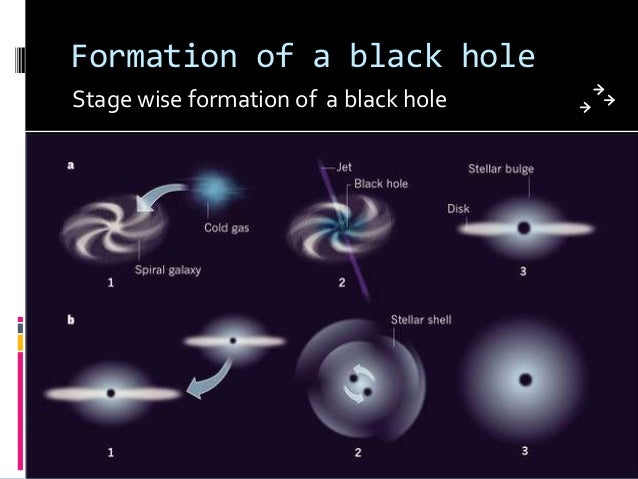
How does a black hole form?
To answer that question, first we need to look up at stars.
 |
| Formation of a Black Hole. |
A star is made up of mostly hydrogen and helium. In other words hydrogen is its fuel. Stars die because they use up all of the fuel that allows a star to undergo fusion. Once a star burns all of the hydrogen, it dies. But these story becomes more dynamic for large stars. Large stars leave behind either a neutron star or a black hole. By absorbing other stars and merging with other black holes, supermassive black holes may form.
Structure of a black hole:
If you look at a black hole, what you'd really be seeing is the event horizon. Anything that crosses the event horizon needs to be travelling faster than the speed of light to escape. In other words its impossible. So we just see a black sphere reflecting nothing. The event horizon is also called "no return point" around the black hole. Its radius is the Schwarzchild radius.
Okay now, if you ask, what will happen if a matter comes to a black hole?
→ Once a matter crosses the event horizon, there is no way back. After crossing the event horizon, the matter will fall into the center. Because of such strong gravity, the matter squishes to just a point.
A black hole has mainly two parts.
• Singularity.
• Event horizon.
The singularity is a tiny volume with a crazy big gravity. It is also the center and is where the mass resides.
The event horizon is the boundary of a black hole.
List of Black holes:
This is a list of black holes and galaxy which has suppermassive black holes at the center.
- 3C 75
- 3C 371
- 4C +37.11 (this radio galaxy is believed to have binary super-massive black holes.)
- APM 08279+5255
- Arp 220
- Centaurus A
- IC 1459
- Messier 31 ( or the Andromeda Galaxy)
- Messier 32
- Messier 51
- Messier 60
- Messier 77
- NGC 1023
Spicy note:
Astronomers have discovered what maybe the most massive black hole ever known in a small galaxy about 250 million light years from Earth, scientists say. The supermassive black hole has a mass equivalent to 17 billion suns and is located inside the galaxy NGC 1277 in the constellation Perseus.
Comments
Post a Comment